Rolling out Copilot, a customer chatbot, or an internal AI assistant is usually a welcome change. Work gets done faster and the team is happy to have the help. But at some point, someone asks a fair question: what data can these tools actually reach? That one tends to catch people off guard, because most AI tools are wired into far more than anyone realizes.
This is the exact gap that DSPM, or data security posture management, was built to close. Before you can trust an AI tool with company information, you need to know where your sensitive data lives, who can access it, and how exposed it already is. DSPM is a data-centric security approach that discovers, classifies, and monitors sensitive data across cloud and hybrid environments, which gives you that picture before AI ever touches it. Think of it as turning the lights on in a room you have been walking through in the dark.
And the room is bigger than most teams expect. Data no longer sits neatly inside a perimeter you can defend. It spreads across cloud storage, SaaS apps, data lakes, and now AI pipelines, and most organizations honestly cannot say where all of it lives. Adding AI on top of that blind spot does not create the risk. It speeds it up.
Why AI Turns a Small Data Problem Into a Big One
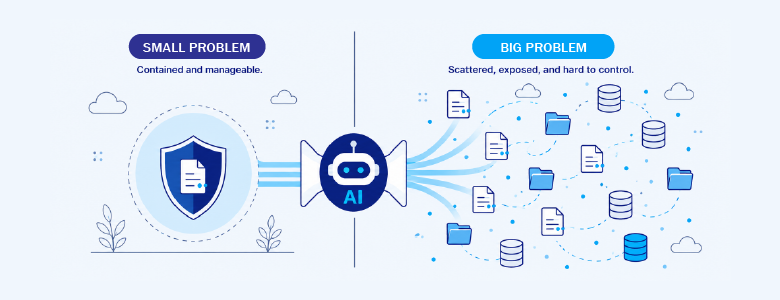
AI became the fastest-moving data flow in most companies almost overnight. Sensitive information now travels into prompts, retrieval systems, copilots, and agents, often without anyone tracking where it goes. A finance lead pastes a spreadsheet into a chatbot to summarize it. An operations manager connects an assistant to a shared drive to speed up reporting. Each move is reasonable on its own, and each one quietly widens the surface where regulated data can slip out.
The deeper issue is that traditional security tools were built to protect infrastructure, not the data itself. They watch networks, endpoints, and devices, but they were never designed to follow a file into an AI prompt or a training set. DSPM flips that model by focusing on the data directly and tracking its movement wherever it goes. That difference matters here, because AI workloads expand the data attack surface in ways older controls simply cannot see, including training data, feature stores, and model artifacts that end up sitting right next to your regulated records. So before we get to the fix, it helps to see exactly how the leaks happen.
The 6 Ways Data Leaks Into AI Tools
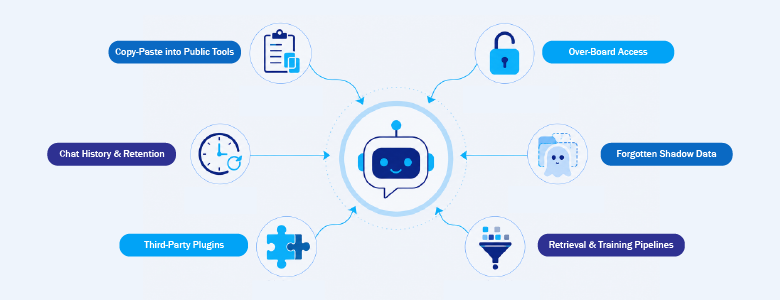
AI data leaks usually don’t look like a hack. They look like normal, everyday work. Here are the six ways it happens most often, and knowing them makes each one much easier to prevent.
Copy-paste into public tools. The most common route is also the simplest. An employee drops sensitive content into a public or unsanctioned AI tool to save a few minutes, and that content may be logged or reused to train the model. The data leaves your control the moment it is pasted.
Over-connected AI assistants. When you point a copilot at a SharePoint site or a cloud bucket, it inherits whatever permissions that location already has. If access was too broad to begin with, the assistant can now surface data that should have stayed restricted, and it does so with a friendly, helpful tone that hides the problem.
Forgotten shadow data. Copies, snapshots, and abandoned data stores pile up faster than anyone tracks them, and no one is monitoring them. If an AI tool indexes one of those forgotten stores, it can expose information you did not even remember keeping.
Retrieval and training pipelines. AI systems that pull from internal knowledge bases or fine-tune on company data absorb whatever is in those sources. Sensitive records mixed into that material can resurface later in a response to someone who was never meant to see them.
Third-party plugins and integrations. Every connector, extension, or API you bolt onto an AI tool becomes another doorway to your data. These add-ons often request wide access, and each one expands the number of places your information can travel to.
Chat history and retention. Prompts and responses are frequently stored, sometimes well beyond the moment they were useful. Sensitive details entered days ago can linger in logs or conversation history, quietly extending the window where that data is exposed.
None of these require bad intent. They happen because the data was reachable and no one had a clear view of where it sat or what could get to it. That is precisely the visibility gap DSPM is designed to fill.
How DSPM Closes the Gap Before AI Gets Involved
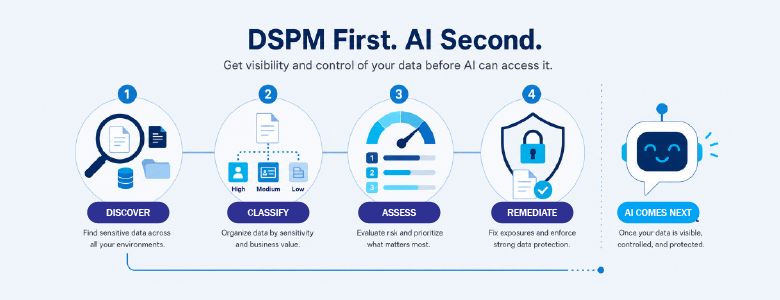
DSPM works in a consistent sequence, and knowing the flow makes it much easier to see where it protects you. It discovers, classifies, assesses, and then helps you remediate.
Discovery comes first. DSPM automatically scans structured and unstructured data across cloud, SaaS, and on-premises systems to build an inventory of what you actually have, including the shadow data most tools miss. Classification follows, labeling data by sensitivity and regulatory obligation so you know which files are ordinary and which carry real risk. This is the step AI security leans on most, because you cannot control what a tool touches if you never identified it as sensitive in the first place.
From there, DSPM assesses exposure by analyzing access permissions, misconfigurations, and how data moves between systems. Instead of treating every finding as equally urgent, it ranks risk by context, meaning who can reach the data, whether it is publicly exposed, and the business impact if it leaks. That prioritization keeps your team focused on what actually matters rather than drowning in alerts. It’s also worth knowing that many DSPM platforms run on scheduled scans instead of real-time enforcement, so it works best as your visibility and posture layer rather than an instant blocker.
Balancing AI Productivity With Data Control
The point of all this is not to slow your AI rollout down. It is to make sure the rollout does not outrun your ability to see what it can reach. Once you know where sensitive data lives and you have tightened the permissions around it, connecting an AI assistant becomes a controlled decision instead of a coin flip.
This is also where DSPM pairs naturally with data loss prevention. DSPM gives you the map of where sensitive data sits, while DLP enforces the rules that stop it from moving somewhere it should not go. One provides the picture, the other acts on it, and together they keep AI adoption from turning into a governance headache later. For local organizations, that same visibility supports compliance under the Data Privacy Act, since you cannot protect or account for personal data you have never located.
Practical First Moves for Teams Adopting AI
You do not need to solve everything at once. A sensible start is to focus on your highest-risk data rather than trying to classify all of it on day one. Personal information, financial records, and intellectual property are the categories that cause the most damage if an AI tool exposes them, so they earn your attention first.
Next, look hard at the access permissions on the locations your AI tools will connect to. Over-broad access is the single biggest reason assistants surface data they should not, so tightening those permissions before you connect anything removes a large slice of risk right away. Finally, treat DSPM as an ongoing habit rather than a one-time scan. Data sprawl never really stops, and fresh copies appear every week, so continuous discovery keeps your picture accurate as your AI use grows. The OWASP GenAI Security Project, which tracks the top security risks facing AI applications, ranks sensitive information disclosure among the most serious, and its guidance points to the same starting move: clean up the data these tools can draw from and limit access on a least-privilege basis so an assistant only reaches what it genuinely needs.
AI is absolutely worth adopting, and the productivity gains are real. The teams that get it right are just the ones who make sure they can see their data clearly before handing it to a tool that never forgets.
Interested in learning more about DSPM and solutions to keep your business safe? Message us at marketing@ctlink.com.ph to set up a consultation with us today!